Enterprise AI activity clusters in the first two waves of BCG's adoption framework. But real value accumulates in the third and fourth, and you can't scale a copilot into either one. What separates the first two waves from the last two is context: AI that knows your domain, your data and how decisions actually get made. And most vendors now selling “context” have never built the kind that AI actually needs.
Key Takeaways
- BCG's four-wave AI adoption framework shows enterprise activity concentrating in chatbots and single-function workflows (Waves 1 and 2) while structural value accumulates in autonomous agents and multi-agent systems (Waves 3 and 4).
- Waves 1 and 2 work without AI understanding your business, which is exactly why scaling them can never produce a Wave 3 outcome.
- The 30%–50% gain BCG attributes to reshaping critical functions should be the floor for the business value your enterprise AI returns, not the ceiling.
- Letting each department choose its own AI model creates a sprawl of disconnected tools with no horizontal contextual layer connecting any of it.
- The easy way to separate real contextual AI from a product rebrand is by asking each vendor, “Who decides which context 'wins’ when two systems disagree?”
I want every AI roadmap to start with this question: which business workflows could operate fundamentally differently if AI understood your company well enough to participate in those workflows end to end?
But almost nobody starts there. They start with an AI tool, a license and a pilot. Then they wonder why AI in year two looks like year one, with a bigger bill.
Why does enterprise AI adoption stall?
Enterprise AI adoption stalls when models keep retrieving answers instead of learning, and then applying in context, what users actually know and how the business actually runs.
I really like the below enterprise AI adoption framework from BCG because it maps that progression cleanly, and it names the gap most roadmaps hide:
- Most companies are working in Waves 1 and 2 where AI supports a single task or one slice of a process.
- But real, tangible business value starts compounding in Waves 3 and 4 where agents run whole processes, and multi-agent systems run the operating model.
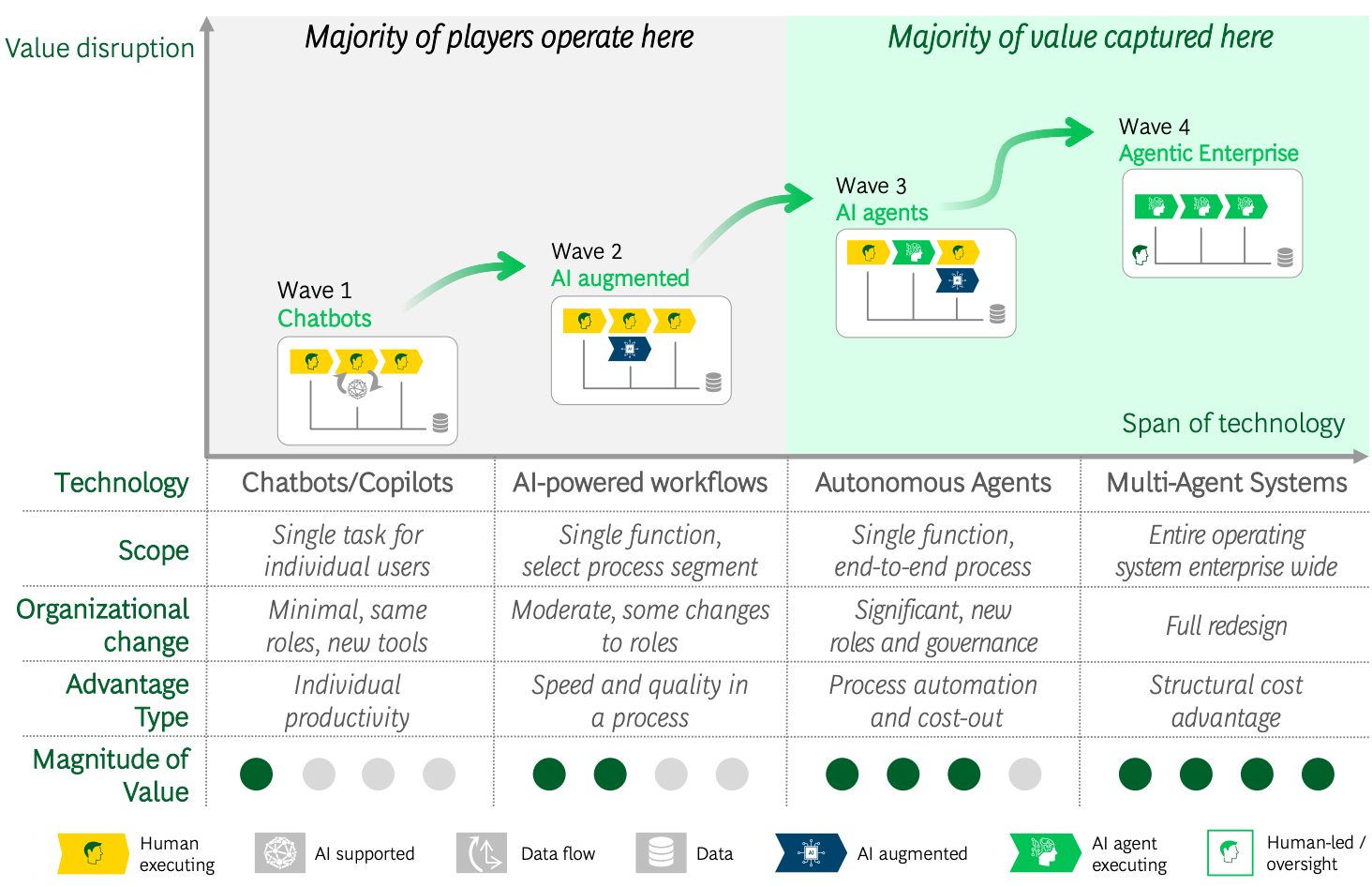
The first two waves never require AI to understand the business it works inside: a chatbot answers a question, and a workflow tool handles one segment of one process. Both perform fine on a general-purpose AI model that has no idea what you sell or how your pricing works.
But Wave 3 is a different kind of work. An autonomous agent running a process end to end must know your domain, your exceptions, your data and what happens when two systems of record disagree about the same customer, among other things. That's why adding capacity to a Wave 1 deployment gives you a faster chatbot, not a Wave 3 agent.
How does business context/institutional knowledge help your business advance from AI-powered workflows to multi-agent systems?
Business context (aka “institutional knowledge”) can move your business from AI-powered workflows to multi-agent systems when it's leveraged by AI as a current, governed map of how your company really operates.
In BCG’s enterprise AI adoption framework, Waves 1 and 2 run on a model's general knowledge of the world. Waves 3 and 4, on the other hand, run on specific, unique knowledge about your business that must always be accurate no matter how much your context keeps changing.
So the hard part in Waves 3 and 4 isn't giving AI more context; it's deciding which context "wins" when systems, policies and teams disagree. Most solutions selling context for AI can’t do this well, if at all (our self-maintaining knowledge graph, on the other hand, automatically figures out which pieces of information are most relevant and current, every time, with no human curation or retraining cycles ever needed).
Why should a 30%–50% efficiency gain be the minimum business improvement you expect from AI, not your end goal?
The 30%–50% efficiency gain BCG calls out in its July 2026 cost advantage report should be the minimum improvement you expect AI to deliver to your business, not the end goal, because efficiency is the automatic, baseline improvement delivered by true contextual AI.
I know this because every day I hear about the significant outcomes enterprises achieve with AI that’s deeply grounded in and automatically updated on their own, unique institutional knowledge. And controlling AI costs is just their starting point.
The organizations we work with are opening new markets, innovating new products and launching new services they couldn't staff before. All because of contextual AI.
For example, we're working with a transportation and logistics company right now that estimates our contextual AI will save them millions of dollars every year on one account relationship alone by shrinking by more than 75% the number of claims that account files. And that huge cost savings is still just a small part of the company’s overall contextual AI success story. The bigger half is that it can then grow its business in massive, material ways by applying that same use case to every high-volume retailer and consumer brand it serves. Leaders will use AI to actually grow their revenues, not just decrease their costs.
Those are the kinds of monumental results we see with enterprises that use our contextual AI. So I suggest you stay highly skeptical of any vendor selling you the main benefit of contextual AI as “do more with less.” That's probably the only outcome that vendor can help you realize (if that...). And real contextual AI can do so much more than that.
How can you tell real contextual AI from the offerings of a vendor that rebranded into “context”?
You can tell real contextual AI from the offerings of a vendor that simply rebranded into "context” by what the architecture does when your business changes.
Four questions sort out this disparity very quickly:
- Does your adaptation layer sit inside or outside the AI’s base model weights?
An adaptation layer that sits outside the AI’s base model weights means AI can reflect a change in your business in near-real time. An adaptation layer that sits inside the weights means you'll have to wait on a retraining cycle for the system to reflect your business changes (and no matter what the vendor slide says, that isn't continuous learning). - How long does data preparation take to deliver the first working AI model?
Most enterprise AI programs burn 6–18 months of data operations to deliver one working AI model, with data prep alone eating 70%–80% of the effort. If a vendor won't time that part of the project for you, they're hiding the least impressive thing about their product. - When two systems disagree, what decides which AI answer is authoritative?
Real contextual AI platforms can give you firm answers about data recency, data lineage and verified memory. Relabeled solutions for context will give you answers that outline a professional services engagement. - Does a correction from one user improve the AI system permanently, for everybody?
With real contextual AI, a correction from one user improves the AI system permanently, for everybody. But if the fix lives in one person's chat history, you bought a chatbot.
The fact that so many vendors adjacent to contextual AI are trying to capture their share of the growing market (Gartner predicts $28 billion for 2026 and $78 billion by 2030) turned into a running joke with my colleagues at an industry event recently. We pointed out two different “context” vendors among the many that were there: one was a storage company six months ago, and the other did data management nine months ago. Now both call themselves context companies, but neither’s actually changed what their product does.
What happens when every department picks its own AI tool without having a unified context layer in place?
When every department picks its own AI tool without having a unified context layer in place, your business ends up with an AI sprawl it can't secure, connect or price.
That feels like 2011–2013 all over again to me, when shadow IT teams were spinning up their own AWS accounts. We fixed that problem by building a layer to properly govern cloud sprawl.
Without that same, governed approach for context, nothing learned by an AI tool persists as deeper meaning for the entire org. And nothing survives the person who learned it; when that person retires, resigns or is laid off, that context walks right out the door with them.
One large, West Coast packaging company I know, for example, runs Microsoft Copilot through its enterprise agreement, Claude in engineering, ChatGPT in sales and Google Gemini in marketing. That means at least four vendors, four security postures, four retail price points and zero shared understanding of the business. And absolutely no business continuity when employees leave.
Who should own the enterprise AI strategy, and when does it need to start?
Your enterprise AI strategy should be owned by the executive accountable for enterprise value, with your CDO or CIO owning the architecture underneath it. And if that enterprise AI strategy isn't already underway, you should start building it right now.
About a third of the people I meet at CDO conferences tell me their company still hasn’t developed any kind of enterprise AI strategy yet. Most are waiting to see what their peers do first (a twisted, AI version of the canary in the coal mine...). I’m always shocked to hear that. To me, having no plan is still a plan. It's just a really bad one.
What shocks me even more are the CDOs who admit they’re terrified to ever start working on an enterprise AI strategy. Some are retiring in 1-2 years. Some work in risk-averse cultures. Whatever the reason, they don't want the slightest chance of something catastrophic happening on their AI watch.
But you can't be afraid to fail. You can’t let fear keep your organization at least 18-24 months behind AI-forward competitors who will keep getting farther ahead every day you wait to begin.
The only way to create as much shareholder value as possible is by entering new markets intelligently and efficiently, launching new products faster than the competition, and running an operating model rivals can't match on cost alone. All the things that come about only when you reach Waves 3 and 4 of BCG’s enterprise AI adoption framework.
What's the best way to build an enterprise AI strategy?
I recommend you build your enterprise AI strategy by answering the question I opened with at the beginning of this blog: which business workflows could operate fundamentally differently if AI understood your company well enough to participate in those workflows end to end?
Then:
- Prioritize those workflows based on how much (and how quickly) you estimate shareholder value will grow if you automate and enrich them via contextual AI;
- Build out the context that will let an AI agent run that first workflow end to end; and
- Do that again, and again, and again...
With real contextual AI, you can build out your first model using this approach in just days.
Then you'll realize the material growth opportunities that immediately start surfacing are the real reason to deploy enterprise AI, not the efficiency gains leaders like you should view as table-stakes.
FAQs
What is contextual AI?
Contextual AI is an enterprise AI architecture that grounds every model output in a continuously updated map of a company's own institutional knowledge, relationships and decision rules. It differs from general-purpose AI, which reasons from public training data and whatever a user pastes into a prompt.
What are BCG's four waves of enterprise AI adoption?
BCG's four waves of enterprise AI adoption run from chatbots and copilots serving individual tasks (Wave 1), to AI-augmented workflows inside a single function (Wave 2), to autonomous agents running an end-to-end process (Wave 3), to multi-agent systems running the enterprise operating model (Wave 4). Right now, most companies operate in Waves 1 and 2, but BCG places the majority of captured value in Waves 3 and 4.
How do you move from AI copilots to autonomous AI agents?
Moving from AI copilots to autonomous AI agents requires a context layer, not a bigger model or more licenses, because autonomous agents need governed access to your domain knowledge, a resolution rule for conflicting sources and an action path into the systems where the work happens.
What is shadow AI (unsanctioned AI tools), and why does it block agentic AI?
Shadow AI is the collection of AI tools and accounts that teams or individuals adopt without centralized approval, governance or shared architecture. It blocks agentic AI because knowledge accumulated in one team's tool never becomes available to the enterprise, and no agent can act across a process it can't see end to end.
Does contextual AI require model retraining in order to reflect business changes?
Contextual AI does not require model retraining to reflect business changes when the adaptation layer sits outside the base model weights. So ask any vendor selling any sort of contextual AI how long it takes for new or changed information to show up in an answer. If they talk about a schedule measured in weeks, you're buying a snapshot that will need perpetual retraining.
How much efficiency improvement should an enterprise expect from AI?
Enterprises reshaping critical functions with applied AI should expect a 30%–50% improvement in efficiency and effectiveness according to BCG's July 2026 cost advantage report. But I suggest you treat that as the starting return from a genuine Wave 3 deployment since real contextual AI delivers significant outcomes above and beyond that threshold.